
Call us now:562-802-3602
Cerritos White Collar Crime Attorney
Experienced White Collar Crime Lawyer in Cerritos
A financial transaction, business decision, or set of accounting records can become the focus of a criminal investigation when authorities suspect fraud or other financial misconduct. If you are facing allegations involving embezzlement, identity theft, or another financial offense, a Cerritos white-collar crime attorney can help you understand the accusations and protect your rights.
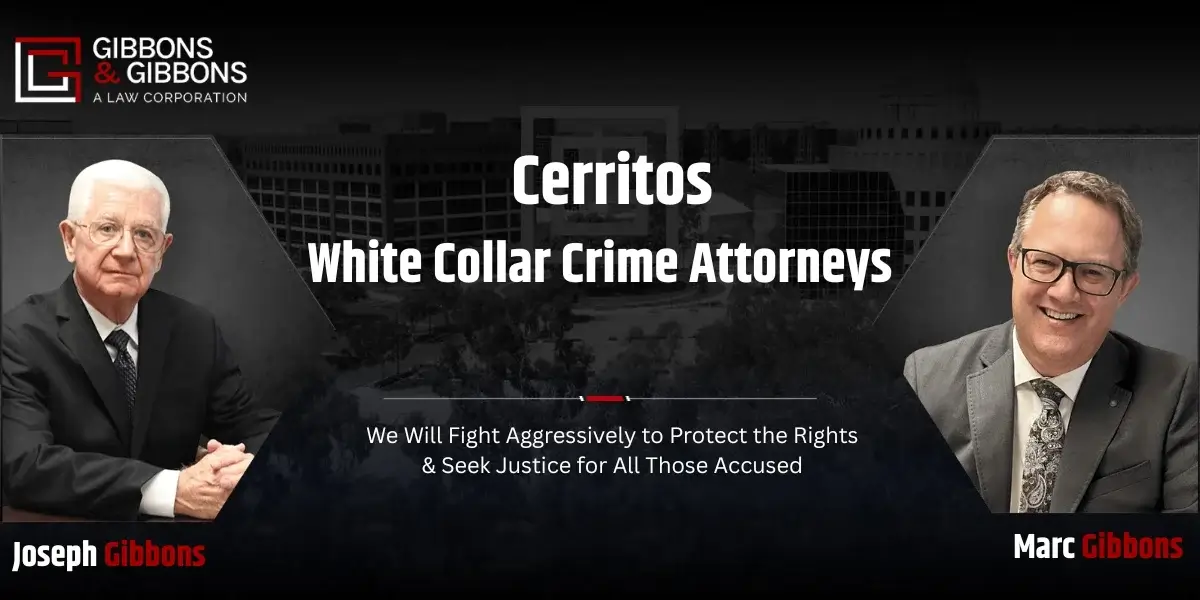
Why Choose Gibbons & Gibbons for White-Collar Crime Defense?
White-collar allegations can be particularly difficult to navigate because financial records, business relationships, and legal requirements may overlap. Gibbons & Gibbons approaches criminal defense with the perspective of a team that has spent decades working within the criminal justice system.
Joseph Gibbons and Marc Gibbons have more than 60 years of combined legal experience. Our practice focuses on criminal defense, and we represent individuals facing misdemeanor and felony charges in state and federal courts.
For someone facing a complex financial investigation, courtroom experience matters alongside careful attention to the evidence. Our approach emphasizes strong advocacy and helping clients understand an uncertain legal situation.
What Offenses Can Lead to White-Collar Crime Charges?
White-collar crime generally refers to financially motivated offenses involving alleged deception, fraud, misuse of funds, or similar misconduct. These cases do not always involve large corporations or elaborate schemes. An individual employee, business owner, financial professional, or other person may face an investigation based on alleged conduct involving money, property, or financial information.
Depending on the facts, allegations may involve:
- Embezzlement. Accusations that someone wrongfully took or used money entrusted to them.
- Fraud. Allegations that someone used deception to obtain money, property, or another benefit.
- Identity theft. The alleged unauthorized use of another person’s identifying information.
- Forgery. Allegations involving the creation, alteration, or use of certain false documents.
- Financial or investment fraud. Allegations involving misleading statements, transactions, or schemes connected to money or investments.
The precise criminal offense depends on the conduct alleged and the law that applies. A suspicious transaction or accounting discrepancy may not establish that someone committed a crime. Investigators must examine the available evidence, and the prosecution must prove the required elements of any criminal charge.
White-Collar Crime Penalties in California
The consequences of a white-collar crime conviction depend on the specific charge, the amount of money or property involved, the circumstances of the alleged offense, and the defendant’s criminal history. Depending on the law and circumstances, white-collar crime penalties may include:
- Fines and repayment of money or property through restitution
- Probation or a jail sentence for certain offenses
- Prison time for certain felony convictions
- Additional financial or professional consequences arising from the conviction
Some offenses may be charged as misdemeanors or felonies, while others have specific classifications and sentencing rules. Federal convictions may carry different penalties under federal law.
An attorney can review the actual charges, explain the potential sentencing range, and identify which facts may affect the outcome. Early legal advice may also help you understand your obligations if investigators contact you before an arrest or formal charge.
What Evidence Matters in a White-Collar Investigation?
White-collar cases often hinge on records and communications rather than eyewitness accounts alone. Investigators may examine bank statements, contracts, emails, electronic files, accounting entries, business records, and statements from people connected to the transactions.
The FBI recorded 859,532 complaints and approximately $16.6 billion in reported losses associated with internet crime. While these figures cover a broad range of reported internet offenses instead of white-collar crimes alone, they illustrate the scale of reported financial harm connected to online criminal activity.
A defense investigation may examine whether the records have been interpreted correctly, whether the accused actually controlled the transaction, and whether the available evidence supports the specific allegations. Depending on the case, relevant issues may include mistaken identity, lack of intent to commit fraud, authorization to use funds, unreliable witness statements, or questions about how evidence was obtained.
An attorney can assess which issues deserve closer review to determine an appropriate defense.
FAQs
What Qualifies as a White-Collar Crime?
White-collar crime generally involves alleged financial wrongdoing, such as fraud, embezzlement, forgery, or certain forms of identity theft. These offenses may involve employees, business owners, professionals, or individuals accused of using deception or misusing money or property. The exact legal classification depends on the conduct. Not every financial disagreement or accounting mistake qualifies as a criminal offense.
How Can a White-Collar Crime Investigation Affect Your Career?
A white-collar investigation may affect employment, professional licensing, business relationships, and your reputation, even before a case reaches trial. The consequences depend on the allegations, the person’s occupation, and any applicable licensing or employment rules. A criminal charge does not establish guilt. Anyone under investigation should consider obtaining legal advice before making statements or providing records to investigators.
When Can Financial Misconduct Become a Criminal Offense?
Financial misconduct may become a criminal matter when the alleged conduct satisfies the elements of a specific offense, such as fraud, embezzlement, or forgery. A disagreement over a contract, an unpaid debt, or an accounting error is not automatically a crime. Investigators and prosecutors must consider the evidence and the applicable law, including any required intent. The distinction depends on the circumstances of the individual case.
Who Investigates White-Collar Crime?
The agency that investigates a white-collar crime depends on the suspected offense and jurisdiction. Local police departments and county investigators may handle certain financial crimes, while the FBI investigates qualifying federal offenses.
Other agencies, including the IRS Criminal Investigation division and the Securities and Exchange Commission, may investigate matters within their respective areas of authority. More than one agency may become involved when an investigation crosses jurisdictions or involves different alleged violations.
Hire a White-Collar Crime Attorney in Cerritos
If you are facing questions about financial transactions, have received a subpoena, or believe you may be the subject of a criminal investigation, do not assume that the situation will resolve itself. When you hire a white-collar crime lawyer at Gibbons & Gibbons, we can help you understand the allegations, evaluate your legal options, and prepare for the next stage of the process.
Our firm is located at 18000 Studebaker Road, Suite 700, here in Cerritos, California. Contact our offices to discuss your situation and learn how we may be able to assist.

Phone
call us now 562-802-3602
© Copyrights 2026 Gibbons & Gibbons. All Rights Reserved.Disclaimer | Site Map | Privacy Policy
Designed by 
*Images are obtained under license from Canva and other third-party stock image providers, with attribution included where required.